The War Was Over. His Service Wasn't: What Civil War Pension Records Revealed

Sometimes a single line in a record changes the entire story. When I opened John Locke's file, I expected a straightforward case. Instead, the Civil War pension record revealed a story that continued long after the fighting ended.
At first glance, his death didn't seem unusual. He died in 1865, after the Civil War had ended. Like many genealogists, I could have easily categorized him as a Civil War veteran who died after the war and moved on to other records.
But one phrase stopped me in my tracks.
John had contracted erysipelas "while in the line of duty."
The war was over.
His service wasn't.

Looking Beyond the Death Date
One of the challenges in genealogy is recognizing when a record doesn't fit neatly into the story we expect.
When I first saw John's death date, I assumed the military portion of his life had already ended. After all, Confederate armies had surrendered, the fighting had stopped, and soldiers were beginning the long journey home.
John never made it home.
Instead, the pension file reveals that he was still serving with the 77th Pennsylvania Infantry. According to the records, he contracted erysipelas during the regiment's movement from Shields Mills, Tennessee, to Victoria, Texas.
That detail immediately changed how I approached the research.
Rather than asking how a veteran died after the war, I found myself asking a different question:
What happened to a soldier whose service continued after the fighting ended?
The Story Hidden in a Pension File
The more I read, the more complicated the story became.
After John's death, his widow applied for a pension based on his military service. Given the circumstances of his death, I assumed the process would be relatively straightforward.
It wasn't.
Her claim was denied.
Yet the story didn't end there.
Eventually, benefits were awarded on behalf of John's children.
As I worked through the file, a picture of the family's circumstances began to emerge. Before her claim was finalized, John's widow remarried. Under pension laws of the time, that remarriage had significant consequences. The records also suggest that the marriage itself was short-lived, leaving the family in an even more difficult situation.
Suddenly, this wasn't just a military story.
It was a family story.
The pension file wasn't simply documenting a soldier's death. It was documenting what happened to the people he left behind.
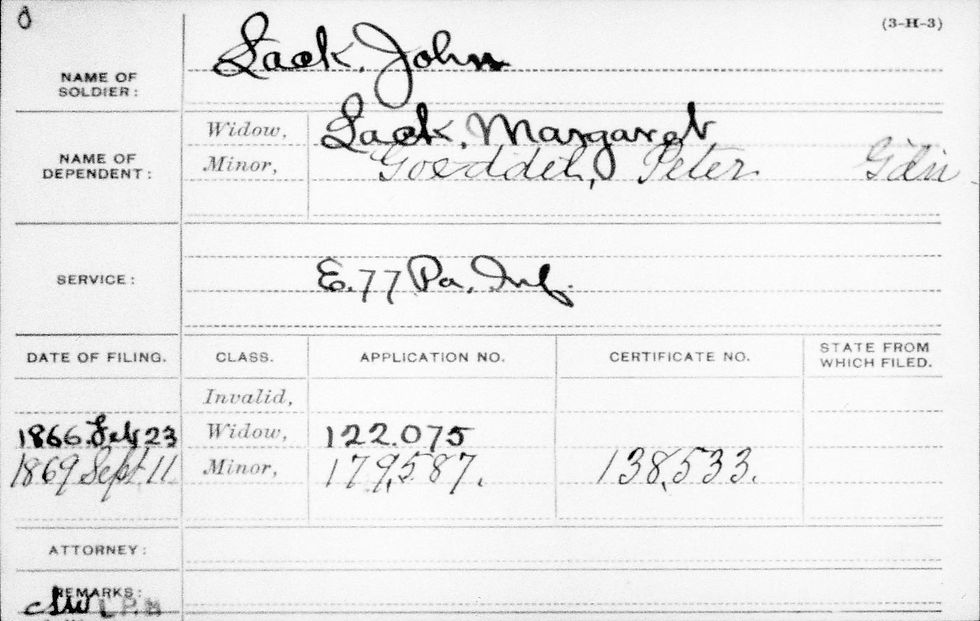
The Questions I Still Have After Looking at John's Civil War Pension Record
One of the reasons I enjoy genealogy is that records often answer one question while creating three more.
At this point, I know that:
John Locke served in the 77th Pennsylvania Infantry.
He survived the active fighting of the Civil War.
He remained in service after the war ended.
He contracted erysipelas "while in the line of duty."
He died before the regiment returned home.
His widow's pension claim was denied.
His children ultimately received benefits.
What I don't yet know is equally interesting.
I'm currently waiting on John's carded medical records and still need to review his Compiled Military Service Record. Those records may help answer questions about his illness, hospitalization, and final months of service.
I'm hoping they will also provide additional context for the events that followed his death.
A Reminder for Civil War Researchers
John's story has been a good reminder that a death date alone rarely tells the whole story.
When we see an ancestor die after April 1865, it's easy to assume the military records have already given us everything they can.
But soldiers continued to serve after the surrender. They continued to march, travel, become ill, and, in some cases, die before ever returning home.
If you have a Civil War ancestor who died in 1865 or shortly thereafter, don't stop at the death date.
Look for the pension file.
Look for the military service record.
Look for the hospital records.
The war may have been over.
But your ancestor's service story might not be.
If you cannot find your ancestor's Civil War records reach out to Brian at Civil War Records to pull the file for you! (affiliate link)


Comments